or May There Always Be Sunshine.
Referencing the children’s song May There Always Be Sunshine (1962), originally written as an anti-war anthem, the work shifts its meaning into a different context. A rat king — bodies entangled into a tightening knot — forms a circular structure resembling a sun. What begins as an image of hope turns into a closed system, where movement only reinforces entrapment.
—————
May there always be sunshine,
May there always be blue skies,
May there always be Mama,
May there always be me.
A work from a four-part series focusing on the condition of choice as a continuous process rather than a resolved act.
Part of a four-part series. Other works can be seen in 2022.
—————
It is always a choice, even after the choice is made —
to love, to hate, to believe, to trust, to care, to ignore, to wait.
I continue to choose every day, realising that I know more and more different important and unnecessary details,
without them my first decision was initially easier.
Yes, I still believe that I have options,
and I am acting as if a new choice would be an easy solution
if I had to make one…
Based on the Jersey Devil legend, the work refers to the story of an unwanted thirteenth child, transformed into a creature and escaping into the surrounding landscape.
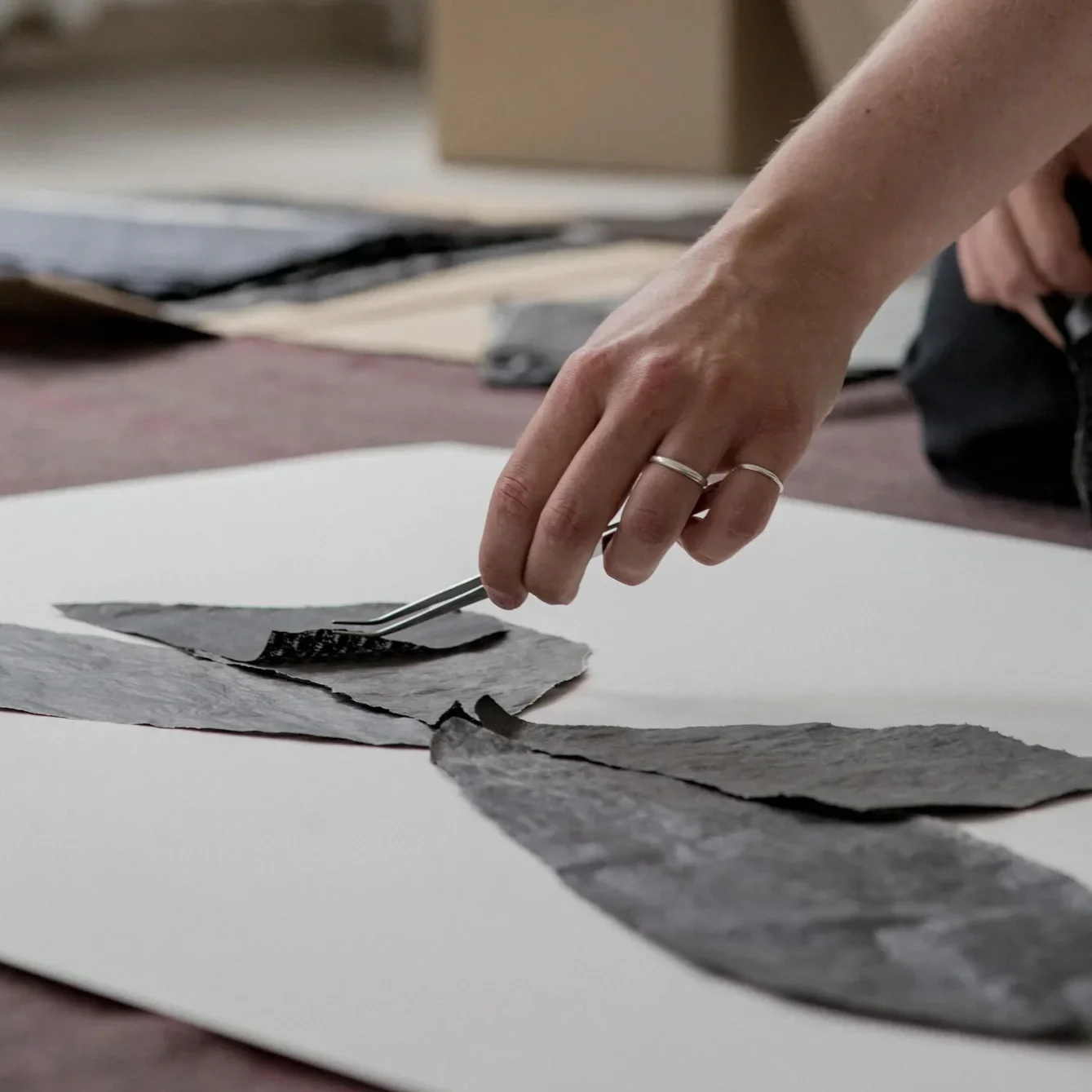
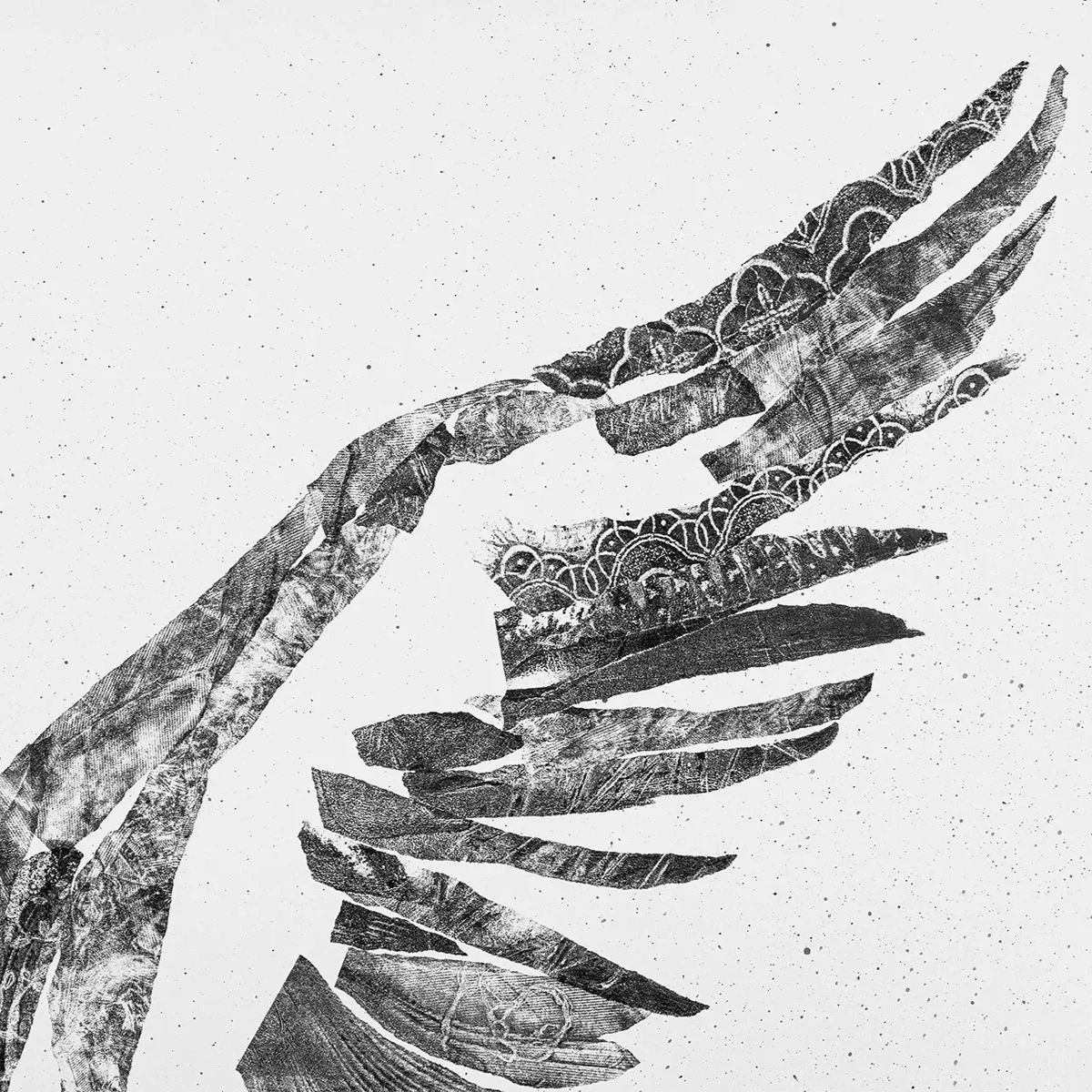
The figure is constructed through fragmented carbon monotype elements, combining animal, skeletal, and unstable forms into a shifting structure.
Developed in 2021 and later becoming part of a site-specific project in collaboration with Lang.
—————
She summoned the devil, saying "let the Devil take him when he is born" (so tired she was of having children) ... and when he was born, she gave him the name Lucas, and he immediately turned into a devil and flew into the steppe through the chimney. The year was 1735.
And there were a huge number of witnesses who faced Him both then and quite recently. They say His head was a horse, cloven hooves, tiny wings of a praying mantis, a long snake-like tail, black fluff, and a wild blood-curdling scream.
He was the thirteenth (unnecessary) child.
A series developed during a residency at TYPA Type and Paper Museum in Tartu, Estonia.
The works focus on imprint, repetition, and the logic of surface, drawing from paleontological forms while remaining grounded in material processes of carbon monotype.
Part of an ongoing exploration of structure through serial variation.
Part of The Time series. The series was supported by a state grant from the Lithuanian Council for Culture and has been presented in exhibitions across Lithuania and internationally.
See the full project: The Time.
—————
The artwork was made after the June 2020 flood in the Carpathian region of Ukraine. More than 5,000 houses in 187 villages were flooded. People were evacuated, but many domestic animals were left behind.
A multi-panel work developed during a residency at the Mark Rothko Art Centre in Daugavpils (Latvia), as part of the 9th International Latgale Graphic Art Symposium.
The composition is built from fragments that resist stable connection, forming an image that shifts between presence and disappearance. The work reflects on time as a structure that cannot be fixed, only partially assembled.
The work became part of the Mark Rothko Art Centre collection.
————-
Time is made of fragments; it falls apart and gathers again in new constellations. It forms memory. It passes, it slips away, it returns. Nothing holds in place. Some fragments vanish, others take their place, and yet they continue to accumulate — you see the image, you recall moments, and when memory loosens its grip, the fragments dissolve, and those moments disappear with them.
(Inspired by endless corridors of ghost buildings of Daugavpils Fortress, Latvia)
Part of The Time series. The series was supported by a state grant from the Lithuanian Council for Culture and has been presented in exhibitions across Lithuania and internationally.
See the full project: The Time.
—————
Nothing can be equal. When something is divided, it never results in fairness. Parts carry different weight — in emotion, in presence, in impact. One part can feel full, another empty; one is still, another restless; one barely fits, another expands beyond its limits. Despite this, all parts remain connected — the same size, the same structure, the same whole.
This period marks a temporary shift in my practice. I work primarily in digital illustration and design, while continuing a parallel line based on carbon monotype. These works extend the Ignitis visual system through colour, exploring how the image behaves in a digital environment. This remains a side branch where monotype and digital processes intersect.
The year is defined by the Ignitis Group project. The work functions as a visual system, where individual images are part of a larger environment. I focus on how images exist within space rather than as separate works. This continues the shift from studio-based work to large-scale projects.
A shift in external conditions leads to a decisive change in the work. I move away from figuration and silhouette, focusing on texture as an independent form. The process becomes less controlled and more responsive to material behaviour. Toward the end of the year, I begin working on the Ignitis Group project, bringing figuration back within a new scale and context.
The work reaches a state of concentration and internal coherence. Series are structured through numbering rather than individual titles. I stop using drawing tools and work strictly within carbon monotype. During this period, Jersey Devil (Thirteenth) is developed, later becoming part of a larger site-specific project in collaboration with Kyle Lang. An interest in paleontology emerges, focusing on imprint, surface, and flatness.
A residency at the Graphic Art Symposium at Mark Rothko Art Centre (Latvia) opens the possibility to work beyond a single sheet. I begin developing multi-panel compositions—diptychs, triptychs, and modular works—and move toward larger formats. The project The Time marks this shift toward structured, large-scale work. At the same time, a more precise line of figurative work continues through the Nabokov butterfly series and further animal studies.
This year the series becomes the core principle of my work. Individual images function less independently and more as part of a larger system. The subject expands to include the human figure, while the underlying serial structure remains unchanged.
The focus shifts from individual works to series. Repetition and variation allow me to stay with one form longer and examine it more precisely. The series becomes the primary structure, and an interest in an encyclopedic way of organising images begins to take shape.
I begin to build a library of textures and working processes. Surfaces are collected, combined, and tested across works. The approach stabilises as a system based on material logic rather than separate images.
The work expands through material. I begin experimenting with coloured tracing paper and additional surface interventions, making the image more layered and complex. The focus moves toward variation within a single form.
2015 marks the beginning of my independent work. Carbon monotype shifts from a technique into a method. I begin to build a visual language through bird forms, pelicans and cormorants. The first exhibition and the use of the name Appias Albina mark this transition into an autonomous position.