Carbon Monotype: Method and Practice
Carbon monotype is an authorial method I developed and continue to refine through long-term artistic, institutional, and educational practice. Emerging from sustained material research, it has been presented in international exhibitions and professional workshops as a distinct visual approach.
Carbon monotype is not a pre-existing medium within traditional printmaking categories. I developed it over many years — shaping its technical structure, visual language, and professional applications through exhibitions, commissions, and teaching.
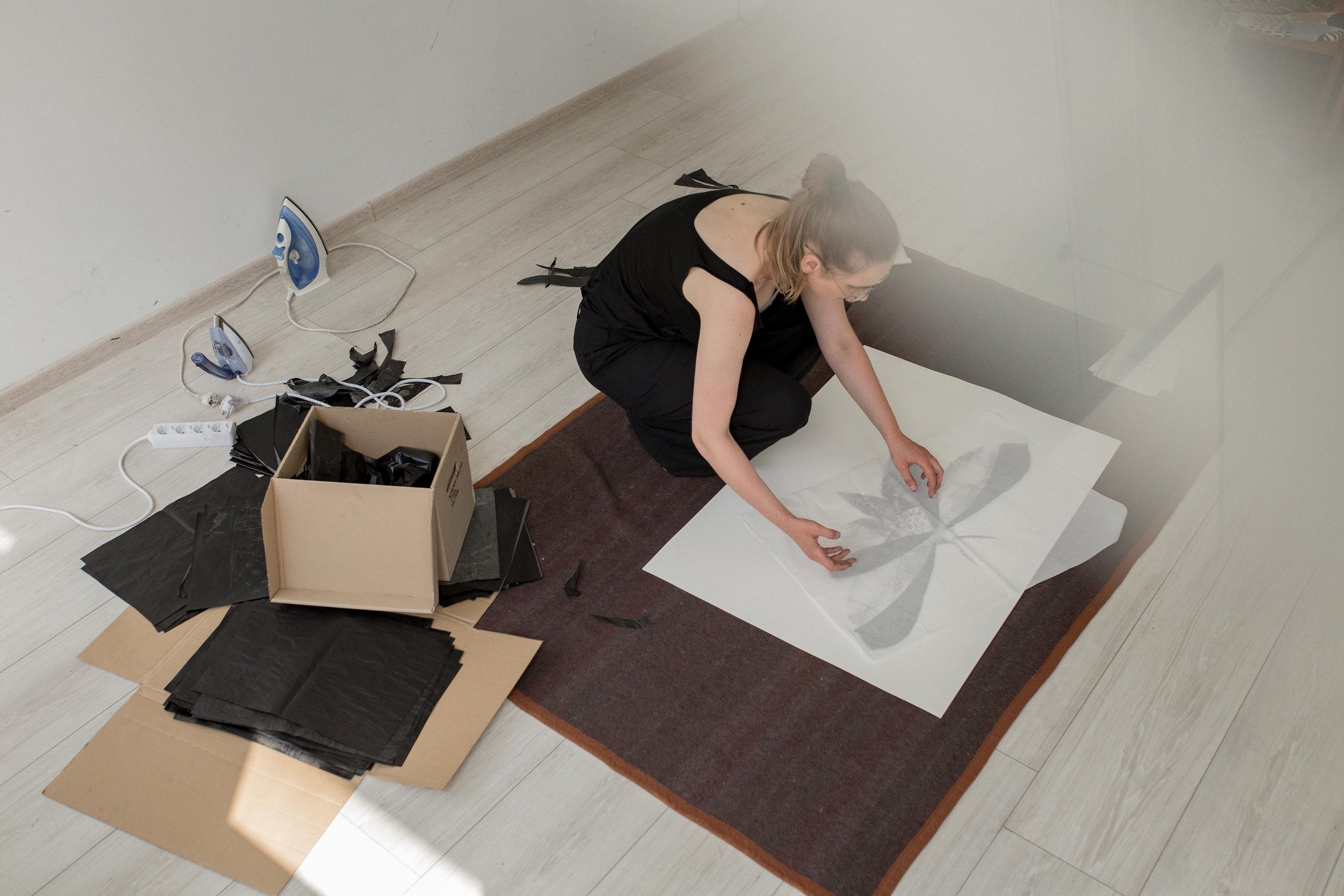
Two-Stage Structure of the Method
At its core, carbon monotype is structured as a two-stage process.
1. Texture Collection and Archive. The first stage is the collection and archiving of textures. I work with natural elements, everyday materials, and industrial surfaces — grass, leaves, fabric, plastic, paper, and found matter. Using carbon copy paper and heat transfer, I record these surfaces as imprints.
Over time, this process forms a growing archive of textures, functioning as a material record of place, time, and contact. This stage relates closely to an archaeological and paleontological way of thinking: preserving traces, layers, and residues before they disappear or are discarded.
2. Image Construction. The second stage of the process is image construction. Returning to the archive, I work through collected imprints by selecting fragments, layering textures, cutting, tearing, and recomposing them into a coherent form.
The silhouette is treated as a structural anchor. I concentrate on anatomical clarity — ensuring that the figure, whether a bird, plant, or organism, remains precise and recognisable. Within this framework, however, the internal textures remain open: they emerge from unpredictable traces and are allowed to shift according to material behaviour and intuitive resonance.
Each work is fixed through a final heat-transfer, after which no adjustment is possible.
Working Rhythm and Decision-Making
This condition of irreversibility defines the working rhythm of the method. Carbon monotype resists control and standardisation. No two works can be identical.
Each step requires decisions that cannot be reversed, where the material itself becomes an active participant in the outcome. If the result fails, the only solution is to start from the beginning.
Material as Memory
Abstract textures in my work function as carriers of memory rather than as descriptive images. Similar to sensory triggers such as scent, they activate associations without relying on narrative representation.
I am interested in how material traces can hold time, place, and lived experience in a non-illustrative way, allowing meaning to remain open and situational.
Scientific Precedent and Clarity
My approach is informed by early scientific and encyclopedic illustration, where organisms were documented through reduction — isolating essential features while removing the incidental.
I adopt a comparable position within my practice: prioritising clarity over decoration. In this sense, form becomes a tool for structuring attention. Both in scientific observation and in visual art, clarity enables perception, understanding, and sustained engagement.
Systematic and Scalable Practice
Carbon monotype functions not only as an artistic practice but as a scalable visual system. It supports both autonomous works and site-specific or institutional applications, maintaining material presence and conceptual consistency across formats.
Тhe method continues to develop through repeated use, critical reflection, and long-term engagement with material and process.